

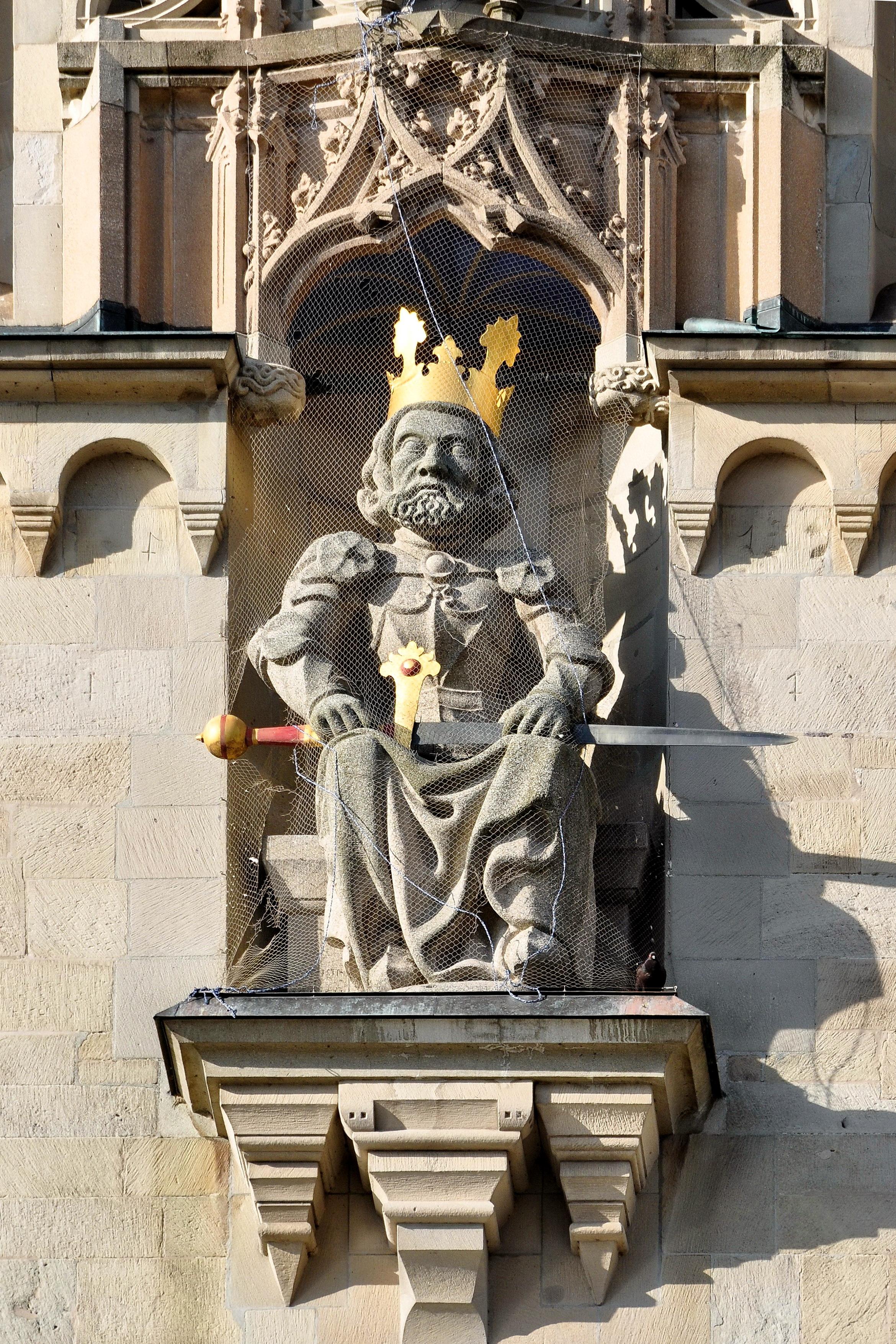
An emperor, a bell for justice and a serpent asking for help: the legend of "Charlemagne and the Serpent" is among the loveliest stories of Zurich's Old Town. It tells of a ruler who listens to everyone, whether human or animal. To this day, Charlemagne sits as a statue on the tower of the Grossmünster.
In this article you will learn who Charlemagne was, what the Zurich legends tell about him and where you can find his traces in Zurich today.
Who was Charlemagne?
Charlemagne, known in German as Karl der Grosse, lived from 747 to 814. He came from the Frankish Carolingian family and ruled a vast realm in Europe. In the year 800 he was crowned emperor in Rome.
Charlemagne died in Aachen, where he had a magnificent palace. Whether he ever visited Zurich is not documented. Nevertheless, he plays an important role in Zurich's legends.
The first legend: the stag and the Grossmünster
According to legend, Charlemagne was out hunting and pursued a stag from Aachen all the way to Zurich. Suddenly his horse fell to its knees, precisely where Felix and Regula, the patron saints of Zurich, lay buried.
Charlemagne took this as a sign. He had the saints' remains raised and, in their honour, founded the church and the collegiate foundation of the Grossmünster. This is how the legend explains why Zurich's best-known church stands on this very spot.
The second legend: Charlemagne and the serpent
The bell of justice
When Charlemagne stayed in Zurich, he is said to have lived in the "Haus zum Loch", right next to the Grossmünster. Near the place where Felix and Regula had been executed, he had a column erected with a small bell.
His order was clear: anyone who had suffered injustice could pull the rope and ring the bell, even if the emperor happened to be at table. Charlemagne would then come himself and hear the complaint.
A plaintiff without words
One day the bell rang, but when the servants looked, no one was there. The next day the same happened. A young servant then hid by the column and waited.
At midday he saw a serpent crawl out of the sand on the shore, coil itself up the rope and ring the bell. Charlemagne came at once and said: "Let justice be done to everyone who appeals to me, be it animal or human."
The verdict
The serpent bowed and crawled back to its nest by the water. Charlemagne followed and saw the reason for its complaint: a large toad was sitting on the serpent's eggs and would not move. The emperor ruled in favour of the serpent and had the toad removed.
The serpent's thanks
Soon afterwards the serpent brought the emperor a precious gem, in gratitude for his just verdict.
The ring and the city of Aachen
The legend goes further. Charlemagne had a ring made from the stone and gave it to his wife Fastrada. The ring had a special power: it bound the emperor so strongly to his wife that after her death he could not part from her.
Only when a bishop took the ring and finally threw it into a body of water could Fastrada be buried. From then on Charlemagne felt drawn to that place and built his palace there. This is how, according to a Rhenish tale, the city of Aachen came into being.
Legend or history?
The Zurich legends about Charlemagne were written down by the chronicler Heinrich Brennwald between 1508 and 1516, about 700 years after Charlemagne's death. No older versions are known, though Brennwald may have drawn on sources that are now lost.
What is historically documented is above all the connection to Charlemagne's family: his grandson Louis the German founded the Fraumünster in 853. The legends thus link Zurich's most important churches with the most famous ruler of the Middle Ages.
The message of the legend
The story of Charlemagne and the serpent is more than a fairy tale. It speaks of justice that applies to all, to the strong and the weak, to people and even to animals. A ruler who listens and judges fairly: this idea appeals to people in every culture. Children in particular love the story, because it is exciting and ends well.
Traces of Charlemagne in Zurich
The statue of Charlemagne at the Grossmünster
On the south tower of the Grossmünster, the so-called Karlsturm, sits a statue of Charlemagne. Look out for him as you walk. Please note: renovation work is taking place at the Grossmünster from 2025 to 2029.
The Haus zum Loch
The house where Charlemagne is said to have lived stands right next to the Grossmünster. It is worth taking a look at the Old Town houses around the church.
The Wasserkirche
Here, near the place where Felix and Regula were executed, the column with the bell is said to have stood. The legend is also connected with the building of the Wasserkirche.
Following the legend: a short walk
All the places lie in the Old Town, only a few steps from one another:
- Wasserkirche on the Limmat: according to legend, the bell of justice stood here.
- Grossmünster: look for the statue of Charlemagne on the south tower.
- Lanes around the Grossmünster: this is where the "Haus zum Loch" stood.
- Across the Münsterbrücke to the Fraumünster, founded by Charlemagne's grandson Louis.
If you know my article about Felix and Regula, you can combine both legends into a single walk.
Frequently asked questions
Was Charlemagne really in Zurich?
It is not documented. The Zurich legends about him were only written down at the beginning of the 16th century.
Where can I see the statue of Charlemagne?
On the south tower of the Grossmünster, the Karlsturm.
Is the legend suitable for children?
Yes. The story of the serpent asking for help is exciting, easy to follow and has a lovely message.
What does the legend have to do with Aachen?
According to a Rhenish tale, the serpent's gem was made into a ring. It is said to have later drawn Charlemagne to the place where he built his palace in Aachen.
Experiencing Zurich's legends with a guide
The legend of Charlemagne and the serpent shows how many stories lie hidden in Zurich's Old Town. Would you like to discover the places of these legends with a guide in Arabic? I would gladly tell you and your family the stories behind the buildings. Write to me on WhatsApp: +41 76 450 11 28.